

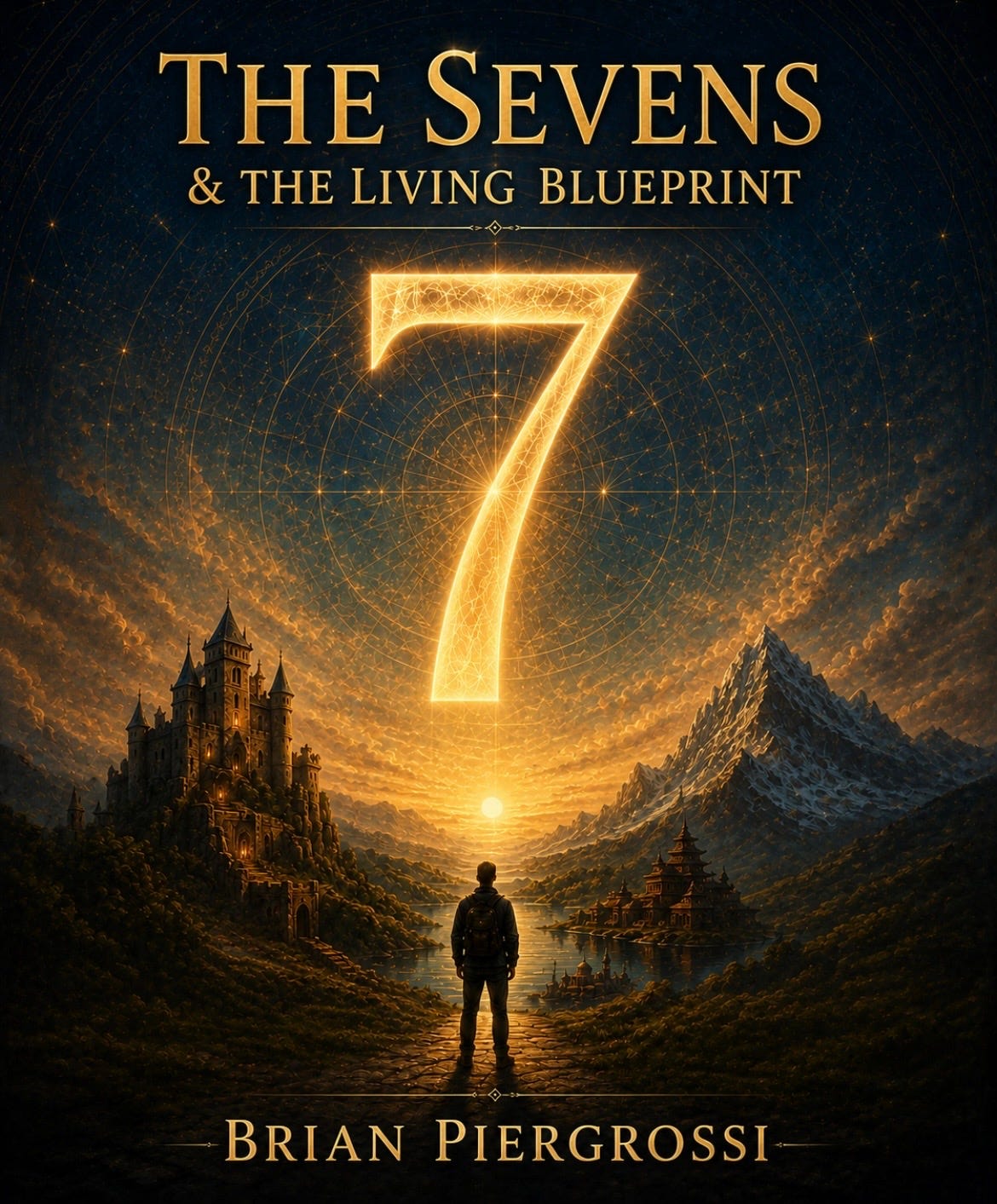
All seven and we'll watch them fall
They stand in the way of love And we will smoke them all
With an intellect and a savoir faire
No one in the whole universe will ever compare
I am yours now
And you are mine
And together we'll love
Through all space and time ‘
Lyrics by Prince from the song ‘7’.
Peaking, not surprisingly, at no. 7 on the Billboard charts in 1992.
Seven appears as a number of spiritual completion and renewal across an astonishing variety of cultures, traditions, times and places.
In the yoga tradition, the human body contains seven primary chakras extending from the base of the spine to the crown of the head.
Root (survival, grounding)
Sacral (creativity, sexuality)
Solar plexus (will, power)
Heart (love, compassion)
Throat (communication, truth)
Third eye (intuition, insight)
Crown (union with the Absolute, enlightenment)
Dormant spiritual energy (Kundalini) is described as ascending through all seven chakras, culminating in complete union of the individual with the Divine at the crown of the head.
In the Gospel of Luke, Mary Magdalene is introduced as a woman from whom Jesus had cast out seven demons (Luke 8:2; Mark 16:9).
Following her deliverance, she became one of Jesus’ most devoted followers, accompanying Him throughout His ministry, witnessing His crucifixion, and becoming the first person to encounter the risen Christ.
In the Gospel of Matthew, Peter comes to Jesus and asks:
“Lord, how often shall my brother or sister sin against me, and I forgive him? Up to seven times”
Jesus said to him, “I tell you not seven times, but seventy times seven.” — Matthew 18:21–22
In elements of Jewish, Christian, and Islamic traditions, there is the belief in seven levels of heaven, with the “seventh heaven” regarded as the highest heaven of all.
In The Interior Castle, St. Teresa of Ávila describes the soul as a castle containing seven mansions, each representing a deeper stage of spiritual growth.
First Mansion – Initial conversion and awakening to the spiritual life.
Second Mansion – Growth in prayer and perseverance.
Third Mansion – A disciplined, virtuous life, relying largely on one’s own efforts.
Fourth Mansion – The beginning of God’s deeper work in the soul.
Fifth Mansion – Spiritual transformation, symbolized by the silkworm becoming a butterfly.
Sixth Mansion – Intense purification, trials, and profound mystical experiences.
Seventh Mansion – Spiritual marriage, the soul’s deepest union with God.
In Genesis there are seven days of creation, and we have seven days of the week, culminating in the ancient Jewish tradition of the Sabbath—a day of completion, renewal, and rest in God, on the seventh day.
In Christian theology we have:
Seven virtues
Seven deadly sins
Seven gifts of the Holy Spirit
Seven sacraments
Seven times Jesus spoke from the Cross
Seven petitions of the Lord’s Prayer
No book of the Bible employs the symbolism of the number seven more than the Book of Revelation.
Revelation opens with messages to the seven churches of Asia Minor and introduces the seven spirits before God’s throne, the seven golden lampstands, and the seven stars held by Christ.
It’s when the seven seals are opened that God’s divine purpose becomes unveiled.
The number seven continues in the seven trumpets, and the seven bowls of God’s judgment, each unfolding in sequence as part of the fulfillment of God’s redemptive plan.
In the Buddhist tradition, the path to awakening is described in part through the Seven Factors of Awakening:
Mindfulness – Awareness of the present moment.
Investigation – Discernment through examining reality.
Energy – Diligence and sustained effort in practice.
Joy – Spiritual happiness arising from progress on the path.
Tranquility – Calmness of body and mind.
Concentration – Deep meditative focus.
Equanimity – Complete mental balance and serenity.
These qualities are cultivated progressively as the practitioner advances toward enlightenment.
After attaining enlightenment beneath the Bodhi Tree, the Buddha spent seven weeks in contemplation before beginning to teach the Dharma.
It’s not just the world’s spiritual traditions, however.
The number seven also appears in the structure of music.
In Western music, the diatonic scale consists of seven natural notes—A, B, C, D, E, F, and G—before the sequence repeats at the octave.
Likewise, in Indian classical music, the basic scale is composed of seven notes: Sa, Re, Ga, Ma, Pa, Dha, and Ni, after which the pattern repeats at a higher octave.
Across these musical traditions, seven marks the completion of a full musical scale before the cycle begins anew.
Across many modern cultures seven is considered the “lucky number.”
Slot machines famously use triple 7s as a jackpot symbol.
The Point
The point here is actually not about the number seven.
I actually don’t care very much about the number seven and I’ll probably never write about it again.
The point is that there is one eternal, living blueprint that comes before, and after any language, that individuals from a wide variety of different cultures, places, and times, have attempted to translate into languages, traditions, and conceptual frameworks.
This does not mean that every spiritual tradition is the same and of equal value.
We’ll explore the differences in style, value, and potency another time.
Some embody a greater fullness of the truth than others
What it does mean is that words lay out the map to the territory, but they are not the territory itself.
We can talk and write about how to know a beautiful forest for eons.
But at some point, if we really want to know that beautiful forest, we need to put down the book and go take a walk inside it.
I want to know God beyond words, ideology, stories, parables, dogma, and fleeting, superficial experiences.
I want to know God the way an unborn child knows its mother’s womb.
I want to know others who want to know God in the same way.
Together I want to hear God say to us:
‘I am yours now
And you are mine
And together we'll love
Through all space and time
So don’t cry
One day all seven will die ‘
—Brian Piergrossi
—————-